
What VacuumTested is
VacuumTested is an independent product research site that catalogs and compares consumer electronics and home appliances — robot vacuums, air purifiers, televisions, projectors, 3D printers, laser engravers, smart rings, self-cleaning litter boxes, IPL hair removal devices and dash cams — using listed specifications and Amazon buyer feedback rather than hands-on laboratory testing.
Guide facts
- Guide type
- Informational buying and maintenance guidance
- Audience
- Robot vacuum owners and buyers
- Evidence standard
- Published testing methodology and model-level review data
How to use this page
- Start with the section that matches your question or household situation.
- Use the linked reviews and best-of lists to compare specific models.
- Recheck current product details before acting on time-sensitive information.
Product examples
What these features look like
These current catalog examples show the product types discussed on this page. Use the linked reviews to check model-specific scores, use cases, and trade-offs.
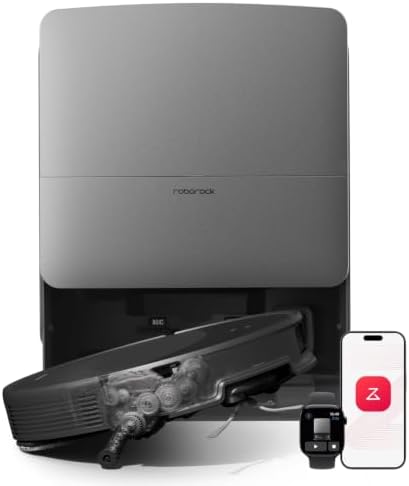
Roborock catalog example
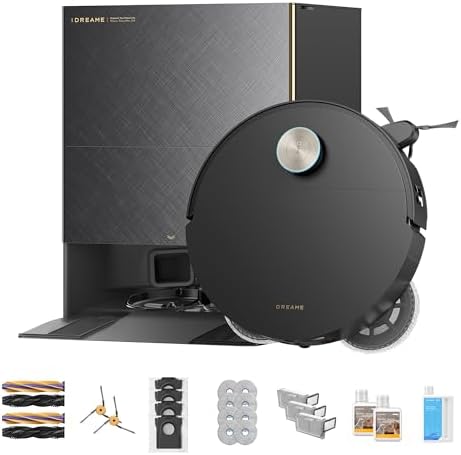
Dreame catalog example
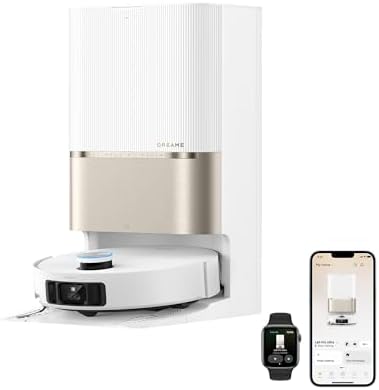
Dreame catalog example
No robot vacuum on the market climbs a staircase. The best of them cross a threshold of about 4 cm, which is a doorway sill or a rug edge, not a 20 cm step. If your home has stairs, the realistic answer is one dock per floor where the robot's map allows it, carrying it up when you think of it, or a stick vacuum for the treads and a robot for the floors.
What this page is: a comparison of what the current robot catalog actually publishes about obstacle crossing, drop detection and multi-level maps, from 49 models across five brands. Where a listing does not state a figure, we say so rather than inferring one from the price.
The number that decides most of these purchases is not suction. It is whether the robot can step over the lip between your rooms, and whether it can hold a separate map for each level once you carry it upstairs.
Can a robot vacuum climb stairs?
No. A staircase riser is typically far taller than any robot's wheel can step over, and the geometry is wrong in a second way: the robot approaches a step from above with nothing to climb onto. What robots are engineered for is the opposite case, a low lip on level ground, and the published numbers make the gap obvious.
| Situation | Typical height | What a robot does |
|---|---|---|
| Rug edge or doormat | 1-2 cm | Crosses routinely; a deep-pile rug is the harder case than the lip |
| Doorway threshold bar | 2-4 cm | Crosses on a model with a liftable chassis; the common failure point on older floors |
| Double-layer threshold | up to about 4.5 cm | Only on models whose listing publishes a double-layer figure |
| Single stair riser | about 18-20 cm | Does not climb, on any model at any price |
| A whole staircase | 2 m or more of rise | Out of scope: the robot would need to descend safely as well |
The 2 to 4 cm row is where nearly every "my robot will not leave the kitchen" complaint comes from. A threshold bar, a stone strip at a floor transition, or a slightly proud hardwood edge is enough to stop a model that has no liftable chassis, and it is the one part of this problem a buyer can solve by choosing a different model.
Which robot vacuums publish an obstacle-crossing height?
Two models in the catalog state a crossing figure on their own product page, and one of those states it in a way that needs reading carefully. The other 47 listings say nothing about it, which is not the same as being unable to cross a threshold, but it does mean a threshold figure cannot be assumed from price or tier.
| Model | Published crossing figure | Source, and what it does not cover |
|---|---|---|
| Dreame L60 Pro Ultra | 8.8 cm obstacle crossing | The figure our catalog carries from the listing. Check it on the current listing before buying: an 8.8 cm crossing is roughly twice what most single thresholds need, and it is still less than half a stair riser. |
| Roborock Saros 20 | 1.77 in plus 1.69 in, described as a double-layer threshold, about 3.46 in or 8.8 cm in total | Roborock's Saros 20 page. It is explicitly a two-layer threshold, not a single step; the manufacturer also states carpet pile up to 1.18 in, which is a separate figure. |
| Roborock Saros 10R | Up to 1.57 in (4 cm) on single and double-layer thresholds; the stated useful range is 0.79 to 1.57 in | Roborock's Saros 10R page. The same page warns against thresholds over 2 cm between a plumbed dock and the cleaning area, which is a dock-installation constraint, not a crossing limit, and the two numbers are easy to confuse. |
Read the Roborock figures as an upper bound under test conditions, not a promise about your hallway. Manufacturers quote best-case thresholds on a flat substrate with a running start; a rounded wooden threshold and a square metal bar of the same height do not behave alike, and a wet mop pad changes the grip.
Why robots do not fall down the stairs
Because they are built to stop at the edge rather than to descend it. Every robot that climbs over a threshold also has to be able to detect a drop, and the two systems pull in opposite directions: one tells the robot to go up, the other tells it not to go over. The detection is usually a set of downward-facing sensors near the front, and it fails in predictable ways.
| What the robot sees | Result | What to do about it |
|---|---|---|
| Open drop, hard floor below | Stops and turns away, normally before the wheels leave the floor | Nothing. This is the system working as designed. |
| Shiny dark flooring at the top of the stairs | Can read as a drop on flat ground, so the robot refuses to cross a patch of floor it should clean | Check for a false drop reading before blaming the robot: a mat or a different cleaning order usually solves it, and some apps let you tell the robot the floor is flat there |
| Dark carpet right up to the nosing | Can read as solid ground, because the sensor needs reflected light | Put a boundary strip or an app no-go zone along the top step |
| Sensor window dusty or blocked by a mop pad | Stops detecting the drop at all; a genuinely risky state near a staircase | Wipe the sensors on the maintenance schedule, and re-check after any pad change |
| Threshold bar at the stair nosing | Reads as something to climb, not something to avoid | No-go line at the top step; a robot that can cross 4 cm is working against you at a staircase |
That third and fifth row is the honest safety point on this page. A robot with a liftable chassis and an 8.8 cm crossing ability is more capable on level floors, and near a staircase the extra capability is not an advantage. The setting that protects you there is a map restriction, not a spec.
What actually works in a house with stairs
There are three arrangements that work, and they differ mainly in how much you are prepared to carry. All three assume the robot cleans floors and something else cleans the treads.
| Arrangement | What you do | What the robot needs | Best fit |
|---|---|---|---|
| One dock per floor | Nothing, beyond emptying and upkeep | A saved map per level, and a second dock or a second robot | Two-storey homes where both floors need daily cleaning |
| Carry the robot up | Pick it up, set it down, start a job, carry it back | Saved multi-level maps so it does not re-map every trip | One main floor plus a smaller upstairs area |
| Robot downstairs, stick upstairs | Vacuum the treads and landing by hand | Nothing beyond the standard map restriction at the top step | Most homes with a staircase, and the cheapest in cash |
The middle option is the one people underestimate. A saved map per floor is a software feature, and it has to be checked per model rather than assumed from a LiDAR badge. One catalog listing states it outright: eufy's shop page says the Omni C20 saves maps for up to three floors. That is the kind of sentence to look for, because without it each carry means a fresh mapping run and a fraction of the floor gets cleaned.
How do you clean a staircase itself?
By hand, with a tool that has reach. A robot cannot stand on a tread, cannot reach the nosing, and cannot get into the corner where the tread meets the riser. A cordless stick with a crevice tool is the usual answer, and it is also what our comparison of robots and cordless sticks concludes: the two cover different jobs rather than one replacing the other.
Two practical notes from the catalogue. First, some current docks ship with a removable handheld or deep-clean attachment for exactly this reason; the eufy shop page describes the E28 station holding a detachable FlexiOne deep cleaner for spills on stairs, carpet and upholstery. Second, the treads are where pet hair and grit accumulate fastest, so if stairs are your only carpet, a stick may be the better single purchase and the robot purely a hard-floor tool.
| Task | Robot vacuum | Cordless stick or handheld |
|---|---|---|
| Open floor at the top and bottom of the stairs | Yes, with a no-go line at the nosing | Yes, but slowly |
| Treads and risers | No | Yes, with a crevice or upholstery tool |
| Nosing and the carpet-to-wood strip | No | Yes |
| Landing | Yes, if it is mapped as its own area | Yes |
| Spills on a tread | No | Yes, spot mode |
What to check before you buy for a multi-level home
Four things, in order of how often they decide the purchase. None of them appear in a suction figure.
- Saved maps per level. Look for an explicit number in the listing. If it is not stated, ask the seller, because a single-map robot in a two-storey house is a robot you carry and re-map.
- Threshold height on the route you actually walk. Measure the lip between rooms, not the doorway. A 3 cm bar in a kitchen entrance is the difference between a robot that reaches the hall and one that does not.
- Drop detection and app no-go zones. Every catalog model that publishes either has a restriction system; what matters is whether you can draw a line along the top step, not whether the robot claims cliff sensors.
- Dock footprint, twice. A second dock is a second piece of furniture. If the upstairs landing is too small for one, the carry option is the only one left.
If your stairs sit between two rooms rather than between floors, the problem is smaller than it looks: one or two steps up to a landing are still a no-go zone, but the landing itself can be mapped as a separate area and cleaned on its own schedule. Our guide to robot vacuum mapping covers what a multi-level map does and does not unlock, and the best-of lists sort the catalog by home type.
How we researched this, and what we did not measure
We read the obstacle-crossing, drop-detection and multi-floor language on each manufacturer's own product or shop page, checked which of the 49 catalog listings state a crossing figure, and compared the published numbers against the height of a real step. Where a manufacturer publishes a figure we link to the page it came from and quote it as their claim, not as a measurement.
What we did not do: we did not climb a robot over a staircase, did not drop-test any model at a stair edge, and did not measure threshold crossing on carpet, gravel or a rounded sill. We also did not test whether drop detection holds on dark flooring; the failure modes above come from how downward-facing sensors work, not from a test we ran. For scores and current prices, use the model reviews linked above; prices change and the figures on this page are not price guidance.
Frequently asked questions
Do robot vacuums fall down stairs?
What is the maximum step a robot vacuum can climb?
Can a robot vacuum clean more than one floor?
Is a robot vacuum or a stick vacuum better for stairs?
Why does my robot vacuum refuse to cross the doorway?
Does a robot vacuum need special settings for a multi-level home?
Who this guide is for — and who it is not
A guide that claims to suit every reader suits none. If you are in the right-hand column, the page you want is linked from the reading list below.
| This guide fits you if | It does not if |
|---|---|
|
|